


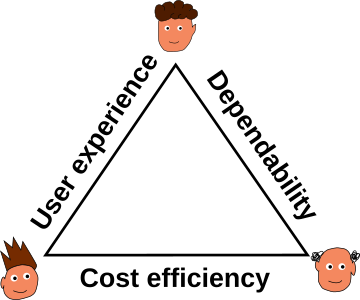
you can't have all three

Italian School BI platform
This school had some of its reports running through Excel until the volume of data increased to the point of being a bottleneck both for efficiency and consistency.
They were inclined to build a backend-frontend architecture, to use a fancy NoSQL database, and to build everything from scratch using PHP. We recommended a unified codebase that saved 30% of what would have been spent on a custom frontend, an old but gold PostgreSQL relational database and Apache Camel as integration tool, Kogito as rule engine, and native browser capabilities such as XML, HTML, CSS and Bootstrap.
We didn't need constant rework as if something breaks every time we add a new feature. This was very strategic for the long game, as we didn't slow down over time.

US Shopify dashboards platform
This startup built a BI platform for Shopify stores to find trends in their sales data through complex analysis such as CAC/LTV and Cohort. However, the system was unstable and unreliable, preventing multiple users at the same time.
They were stuck with the idea of building a state-of-art cloud native solution with realtime capabilities and two databases, but this started to become too complex for big stores. We recommend a Linux virtual machine solution that could run the long jobs in background, developed a D-1 only solution instead of realtime that was good enough, and redesigned the PostgreSQL database to be fast enough without requiring a second database.
The platform became more stable, it could scale to more users, and the rest of the team could add new features without worrying that everything breaks all the time.
US Real Estate webscrapper
One realtor needed to ingest foreclosure data from multiple counties and to match it with his proprietary database to find good deals. This should be a one-off thing, not a system that requires constant maintenance.
His first approach was a two-people team, one junior React frontend developer and a senior for the backend in Python. We suggest getting rid of the frontend part because it was taking too long to finish and use the browser native capabilities only. Plus, all the backend was done using the Apache Camel integration tool that linked the foreclosures sources with the OCR and AI APIs and all the advanced match was done using the PostgreSQL database native capabilities.
The system was delivered on budget and there was a bug only once, that was caused by the county from where we collect the data, so we added a simple monitoring interface.
not harder
can be expensive
more than you can chew
over customization
cut once
is more
but gold
doesn't fit all
to kill a mosquito
mightier than the answer
the wheel
at a time
smooth is fast

W3C
The most standarized recommendations for web based on open debate (Request For Comments).

PostgreSQL
The most advanced OpenSource database based on Relational Algebra.

Apache Camel
The most versatile OpenSource integration tool based on Enterprise Integration Patterns.

KIE
The leading OpenSource business automation tool based on Business Process Model and Notation and Decision Model and Notation.

KeyCloak
The most secure OpenSource access control tool based on OAuth, OpenID Connect and JWT.