How to build a SUCCESSFUL
SaaS?

Risk mitigation
is the secret of every lucky entrepreneur

House of cards
Operation

If your software has many bugs, the clients will lose trust. An unstable product is bad for business.

So, you'll put extra effort to catch these bugs before the client sees the next version, right? Well, this will increase your costs, slow down your shipment, and masquerade the issue. Soon, your product will be costing so much and taking so long to evolve.

Instead of stabilizing something unstable, a better strategy is to build something stable by hiring an experienced developer that can actually say no for bad ideas. A different point of view can eliminate many risks, but someone that never disagrees with you will jeopardize your business.
A suspicious shortcut at night
Marketing

Your client may not believe in you if he doesn't know you, and he won't know you if he doesn't believe in you. Kind of a catch 22, right?

You need a wingman, someone that vouch for you. It can be a platform, it can be a supplier that provides an API or infrastructure. This not only reduces the risks of your enterprise, but also gives you credibility.

Normally the partner will take part of your margin, but it's better to have a smaller margin than no margin at all when you have no credibility.

Metaverse goggles
Finance

Instead of planning the wedding before actually going on a date, go on a date first, ask what your partner wants for dining and split the bill.

That's why the SaaS model has become so popular nowadays. Instead of spending thousands of dollars in R&D to sell off-the-shelf software, the idea is to get the client in the loop and to sell technical hours instead.

The icing on the cake is that you can split the technical hour cost across clients that want something similar. But, for this to work out, the fewer clients you have the better because you need eye to eye communication, so start focusing on high-ticket clients. To scale, you'll need a data analysis department to discover what the users want.
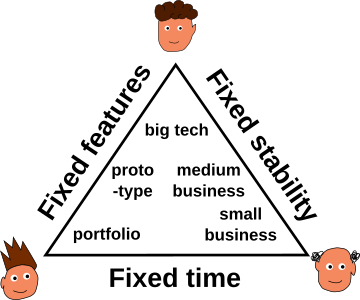
Technology isn't about software,
it's about people.

The major liability in the tech industry is professionals that deliver fast, make every stakeholder happy, and change jobs from 6 to 6 months because he can't maintain what he created. Nowadays, it's even worse, you have AI that does exactly this, and when the software breaks, loses or leaks data, you don't have anyone to blame, because AI is not a person.

It's the people you hire that make your product thrive. They may request more time to deliver and they may say no for some ideas, because they already tried and failed so you don't have to. But, they will make you win the long game with the resources you have available. It is so true that technology is not about software that open source software provides free software, free source code and only charges for training and consultancy.

In AI golden rush ages,
who sell shovels strike it rich.

AI was trained with poor public data from the web, and it eventually hallucinates. Big Techs can use AI to increase the productivity of software engineers, because they have an army to review and fix the generated code. SMBs can't afford the same review process. As AI increases Big Tech productivity, it will increase the turnover as well. This means experienced talents available to SMB to hire. It is about time SMB could afford digital transformation.

On the other hand, Big Techs normally don't hire programmers without experience and degree. SMBs are responsible already for most non-degree programmers' first job. With the right direction of experienced developers, SMBs’ digital transformation project can thrive and generate even more first jobs for hands-on developers. Because every programmer wants to work for a big tech at some point of his career, there is a big pool of talents willing to join SMBs’ projects to gain experience.

Are you looking for a simple technology?