How to simplify
digital
transformation?

A fruitful product depends on a creative idea...
And a little bit of analytical thinking

“If I had asked people what they wanted, they would have said faster horses.”

Creative people belong on stage. They allow themselves to think outside of the box to solve problems that others can't. But, this also means that the original solution may be too complex and brittle to make the ends meet.
Analytical people belong backstage. Analysis means to break something down into pieces, to weigh the trade-offs, and to reassemble in a simpler way in order to keep the operational costs under balance.
We are here to help you all the way from idea to success.
It's a trade-off,
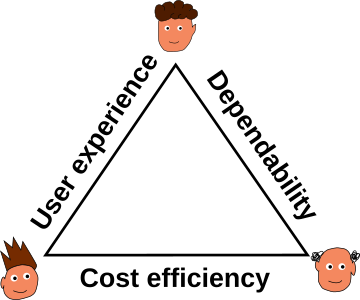
you can't have all three

A triangle showing the trade-off among User experience, Dependability and Cost efficiency
User Interface (UI) customization is free, User Experience (UX) isn't. It increases the complexity because you have to bend the system architecture. Complexity makes bugs happen everywhere. If you decide to fix complex bugs, you'll have an endless work called technical debt.
If you think that you need bells and whistles just like facebook.com, think how come the fair and square amazon.com is selling like water in the desert? The truth is that the client cares more for the painting than the frame. If you don't have competitors, he will buy any frame that have the painting the like.

People only pay extra for perceived value

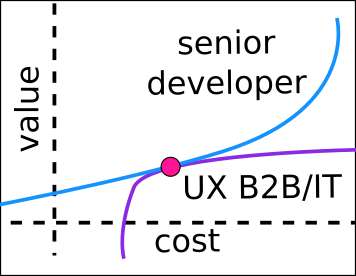
A graph showing how the increase cost on UX is perceived as value in B2B or internal tool projects, and how a senior can fit in this scenario.
In the B2C market, there is high competition. An improved User Experience can impact directly the revenue, because the client will choose the best UX he can afford.
It is impossible to compete with a BigTech in the B2C market if you're a SMB and don't have thousands of developers. You won't be able to afford the infrastructure to support the same User Experience.
In B2B or internal tools, the client is not a user. He doesn't care about the UX, he won't pay more for something he can't perceive.

It's tempting to surf
the last technology fad

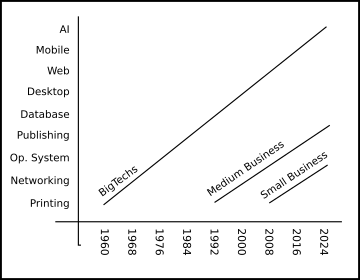
A graph showing how the technology is adopted first by BigTechs and then by Small Medium Business.
You can't deal with a more complex technology if you can't deal with a simpler one first.
In 2016, every entrepreneur wanted to enter the mobile market. How expensive could it be to build an app? They learned that the app itself was cheap, the expensive bit is the backend behind it.
Let's use the cloud then! And then they learned that the cloud accelerates the building, but the biggest cost is the operation.
This also happened in 2008 with Web, and 2000 with Desktop.

While .com is the king of web,
.cn and .de are growing fast on second

You can't do business in China or Germany without a website. It is just impossible to do business meetings with every single company. If you can't get an idea of the business through the website, you skip to the next competitor.
But, nobody expects your website to have an incredible experience. It needs to be informative, useful, not fancy. And the most important thing, it must be affordable for a Small Medium Business to have it.
While .com websites are normally expected to have a facebook.com level of interactivity and dominate B2C, SMB .cn and .de are growing faster with simplicity on B2B and Internal Tools.